
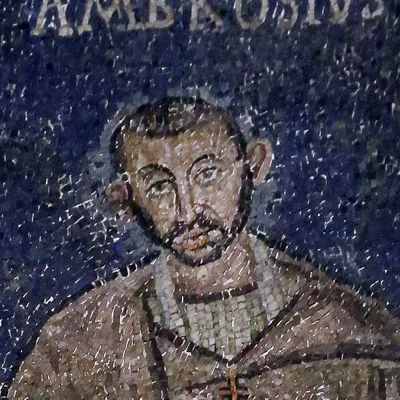
Ambrosius Mediolanensis
Saint Ambrose of Milan
Bishop of Milan, Doctor of the Church
A Roman governor acclaimed Bishop of Milan while he was only a catechumen, he defended the faith of Nicaea, stood up to emperors, baptised Saint Augustine and gave the West its first hymns.
Born around 339 at Trier, where his father was praetorian prefect of the Gauls, Ambrose grew up in Rome, studied law and entered the imperial administration; around 370 he was governor of the province of Aemilia-Liguria, at Milan. In 374 the death of the Arian bishop Auxentius divided the city; having come to calm the assembly, the governor was acclaimed bishop by the crowd. A mere catechumen, he was baptised, ordained and consecrated on 7 December 374. He distributed his goods to the poor and put himself to school with the Greek Fathers, guided by the priest Simplicianus.
A tireless pastor, he fought the Arianism supported by the Empress Justina: in 386 he occupied with his people a basilica which she wished to hand over to the Arians, and there were sung for the first time in the West hymns in alternating choirs, which he composed himself. He obtained the maintenance of the removal of the altar of Victory from the Senate (384), imposed on the Emperor Theodosius a public penance after the massacre of Thessalonica (390) and discovered the bodies of the martyrs Gervasius and Protasius (386). In the night of Easter 387 he baptised Augustine, whom his sermons had led to the faith. He died on Holy Saturday, 4 April 397, and rests in the basilica of Sant’Ambrogio in Milan, between Gervasius and Protasius. His treatises on the sacraments, virginity and the duties of clerics, and the Ambrosian rite which bears his name, make him one of the four great doctors of the Latin Church.
Where Peter is, there is the Church.
Celebrated on the same day
Saint John the Silent
Bishop turned hermit at the laura of Saint Sabas
Saint Fara
Founder and abbess of Faremoutiers
Saint Maria Giuseppa Rossello
Foundress of the Daughters of Our Lady of Mercy
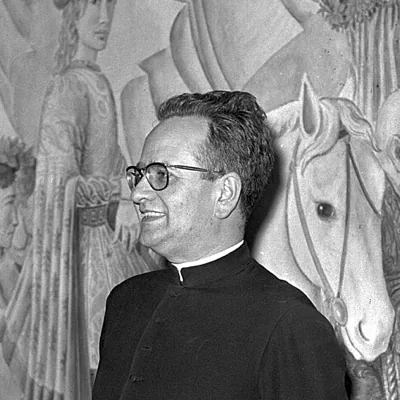
Servant of God José María Hernández Garnica
Priest, pioneer of Opus Dei in Europe
In the same region
Blessed Angelina of Marsciano
Foundress of the Franciscan Sisters of the Third Order Regular
Blessed Anna Rosa Gattorno
Widow, foundress of the Daughters of St Anne
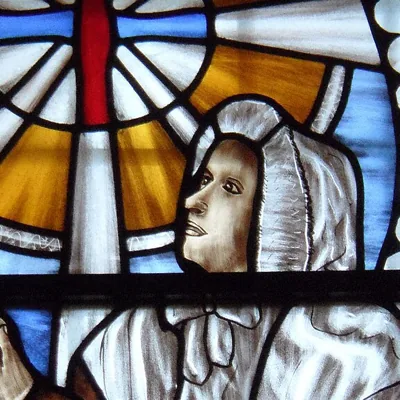
Blessed Anna Maria Taigi
Mother of a family and Roman mystic