
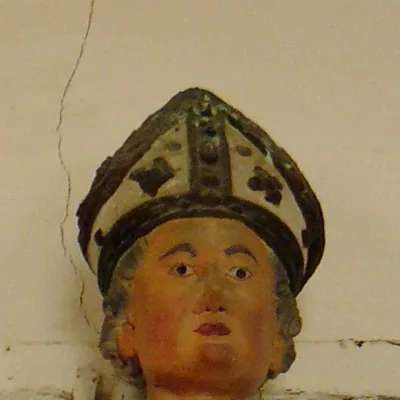
A missionary priest of the Cotentin and founder of the monastery of Nanteuil, he became, through his relics kept at Corbeny, the saint associated with the royal touch for scrofula.
Born at Bayeux towards the end of the fifth century, Marcouf was ordained priest by the Bishop of Coutances. He evangelised the east of the Cotentin and the Channel Islands, where he left his disciple Helier on Jersey, and readily withdrew to the islets that now bear his name, the Îles Saint-Marcouf. He founded at Nanteuil, present-day Saint-Marcouf-de-l'Isle, a monastery that he governed as abbot. He died there around 558, in the presence of Saint Lô, Bishop of Coutances.
To save them from the Vikings, his relics were carried off in 898 to Corbeny, near Laon, where King Charles the Simple gave refuge to the monks of Nanteuil. There they acquired the reputation of curing scrofula, a tuberculosis of the glands of the neck. The link between this power and the one attributed to the kings of France was established only gradually: the royal touch is attested from the early twelfth century, under Louis VI, by Guibert of Nogent, but the pilgrimage of the kings to Corbeny appears only in the fourteenth century.
From Louis X to Louis XIV, the kings went on pilgrimage to Corbeny the day after their coronation at Reims before touching the sick with the formula “The king touches you, God heals you”. From Louis XIV onwards the relics were brought to Reims, to the abbey of Saint-Remi, where the touching took place. The relics, hidden during the Revolution and then during the Great War, are still kept in the church of Corbeny, and his cult remains alive in Normandy, notably in the two villages of Saint-Marcouf.
Celebrated on the same day
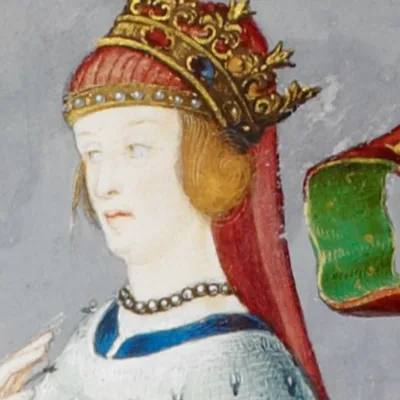
Blessed Mafalda of Portugal
Reforming nun of Arouca
Blessed Julian of Valle
Franciscan peacemaker of Istria
Blessed Klymentiy Sheptytsky
Archimandrite of the Studites, Righteous Among the Nations
The Seven Apostolic Men
First bishops of Hispania according to tradition
Saint Amator of Auxerre
Bishop of Auxerre
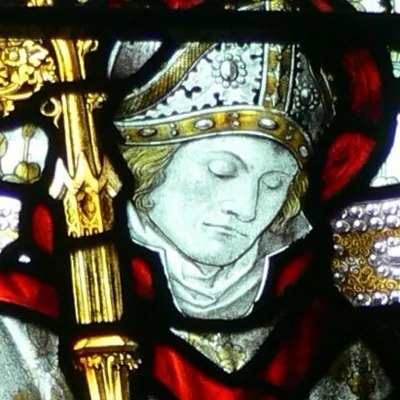
Saint Asaph
Abbot and bishop of Llanelwy
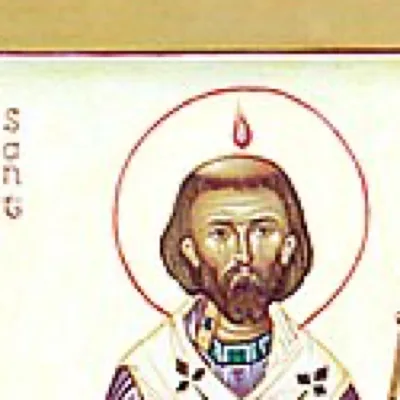
Saint Brieuc
Founding abbot of Saint-Brieuc
Saint Orientius of Auch
Bishop of Auch, poet
Saint Peregrine Laziosi
Servite of Forlì, patron of cancer patients
Saint Riccardo Pampuri
Country doctor, brother of Saint John of God
Saint Sigismund
King of the Burgundians, founder of the abbey of Saint-Maurice
Saint Tamar
Queen of Georgia
Venerable Guido Schäffer
The “surfer saint” of Rio
In the same region
Blessed Adèle de Batz de Trenquelléon
Foundress of the Daughters of Mary Immaculate
Blessed Agnes of Langeac
Dominican mystic of the Velay
Blessed Alix Le Clerc
Foundress of the Congregation of Notre Dame