
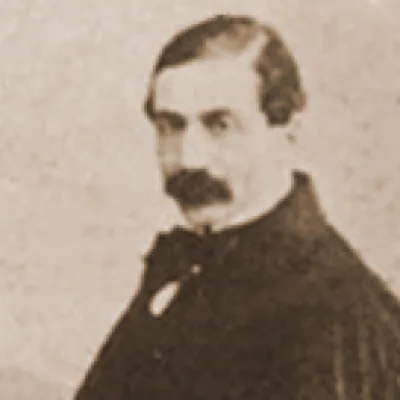
An officer of the Sardinian army, a mathematician trained at the Sorbonne and a professor at the University of Turin, he founded a work for domestic servants and poor women and became a priest at the age of fifty-one.
Francesco Faà di Bruno was born in 1825 at Alessandria, the youngest of the twelve children of a noble family. An engineering officer, he fought in the first war of independence, then left the army to study mathematics in Paris, at the Sorbonne, where he followed the teaching of Augustin Cauchy. A doctor, he taught at the University of Turin; he is notably remembered for a formula for the differentiation of composite functions that bears his name.
Moved by the condition of maidservants and poor women in Turin, he founded the Work of Saint Zita, which received them, instructed them and helped them, then built the church of Our Lady of Suffrage, whose tall bell tower dominates the district of San Donato. Ordained priest in 1876 thanks to the support of Don Bosco and Pius IX, he founded in 1881 the Minim Sisters of Our Lady of Suffrage. He died in Turin on 27 March 1888; John Paul II beatified him in 1988.
Celebrated on the same day

Blessed Panacea de’ Muzzi
Young shepherdess, martyr of Quarona
Blessed Louis-Édouard Cestac
Founder of the Servants of Mary of Anglet

Saint John of Lycopolis
Hermit and prophet
In the same region

Blessed Angelina of Marsciano
Foundress of the Franciscan Sisters of the Third Order Regular
Blessed Anna Rosa Gattorno
Widow, foundress of the Daughters of St Anne
Blessed Anna Maria Taigi
Mother of a family and Roman mystic