
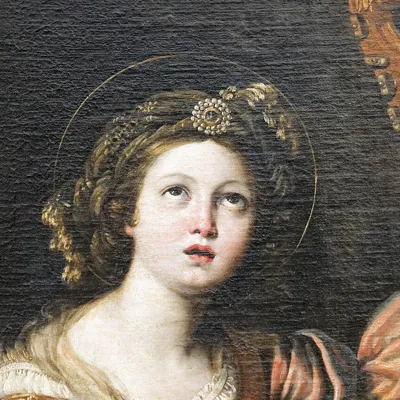
A Roman martyr named in the Roman Canon, whose name has designated since antiquity a church in Trastevere; her legendary Passion made her the patroness of musicians.
Of the history of Cecilia little is certain: a titular church in Trastevere has borne her name since the end of the fifth century, her cult is attested in the oldest Roman liturgical books, and her name appears in the Roman Canon of the Mass. The Roman Martyrology cautiously reports that she “is said to have obtained” the palm of martyrdom and that she was buried in the cemetery of Callixtus, on the Appian Way, where her crypt is shown near that of the popes. The date of her death is unknown; it is most often placed in the third century.
Her Passion, composed around the end of the fifth century, is largely legendary: a young patrician vowed to Christ, Cecilia converted her husband Valerian and his brother Tiburtius, who died martyrs before her; condemned to perish suffocated in the bathroom of her house, then struck three times with a sword, she survived three days. A sentence of this account, taken up by the liturgy, shows her singing to God in her heart while the instruments played at the wedding: this is the origin of her patronage of musicians, which established itself from the end of the Middle Ages.
In 821 Pope Paschal I transferred her remains from the catacombs to the basilica of Santa Cecilia in Trastevere, which he had rebuilt. When the tomb was opened in 1599 the body is said to have been found intact, lying on its side; the sculptor Stefano Maderno represents it thus in the famous marble statue placed beneath the altar.
Celebrated on the same day
Bienheureux Salvatore Lilli
Franciscain, missionnaire en Arménie Mineure, martyr
Bienheureux Salvatore Lilli et ses sept compagnons
Martyrs de Marach
Saint Ananias of Arbela
Martyr of Persia
Saint Pedro Esqueda Ramírez
Apôtre du catéchisme à San Juan de los Lagos
Saints Philémon et Apphia
Chrétiens de Colosses, disciples de saint Paul
In the same region
Blessed Angelina of Marsciano
Foundress of the Franciscan Sisters of the Third Order Regular
Blessed Anna Rosa Gattorno
Widow, foundress of the Daughters of St Anne
Blessed Anna Maria Taigi
Mother of a family and Roman mystic