
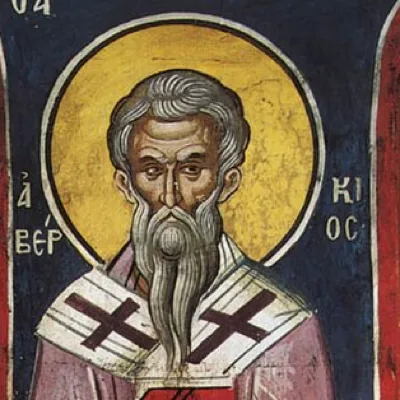
A Phrygian bishop of the 2nd century and author of the famous epitaph which evokes, under the symbol of the fish, the Eucharist shared by Christians from Rome to Nisibis.
Bishop of Hierapolis, a small town of Phrygia Salutaris near Synnada, Abercius lived under Marcus Aurelius. His Greek Life, written in the 4th century, relates that he overthrew by night the statues of a pagan temple and explained his reasons the next day in the agora, and that he travelled to Rome and as far as Syria and Mesopotamia, which earned him in the East the title ‘equal to the apostles’.
At the age of seventy-two he had a verse epitaph engraved for his tomb. In it he calls himself ‘disciple of the chaste Shepherd’, tells how he saw Rome and crossed the Euphrates as far as Nisibis, and how everywhere faith served him as food ‘the Fish from the spring’, caught by a pure virgin, with wine mixed with bread. This veiled language of the Eucharist makes it one of the most precious Christian testimonies of the 2nd century.
Fragments of the stele, found in 1883 by the archaeologist William Ramsay near ancient Hierapolis, were presented to Pope Leo XIII and are kept in the Vatican Museums. The Roman Martyrology commemorates him on 22 October.
I am the disciple of a pure Shepherd, who feeds his flocks of sheep on mountains and on plains.
Celebrated on the same day
Saint Bertharius of Monte Cassino
Abbot of Monte Cassino, martyr of the Saracens
Saint Donatus of Fiesole
Irish monk, Bishop of Fiesole
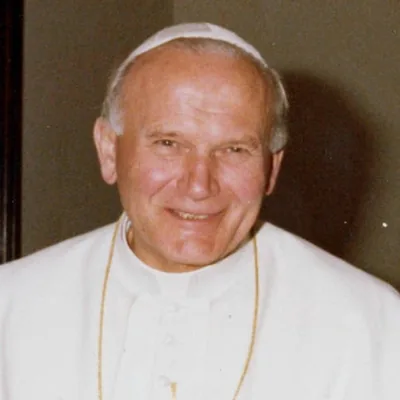
Saint John Paul II
Pope from 1978 to 2005
Saint Mark of Jerusalem
First bishop of Jerusalem of pagan origin
Saint Mellon of Rouen
First bishop of Rouen
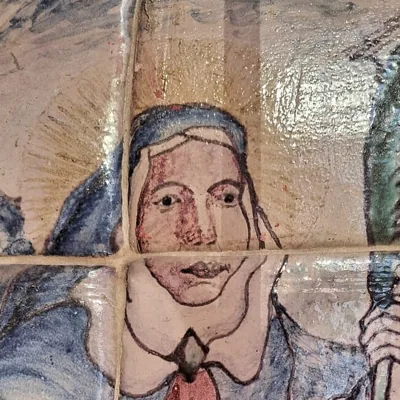
Saints Nunilo and Alodia
Sisters, virgins and martyrs of Huesca
Saints Philip of Heraclea and Hermes
Bishop and deacon, martyrs
In the same region
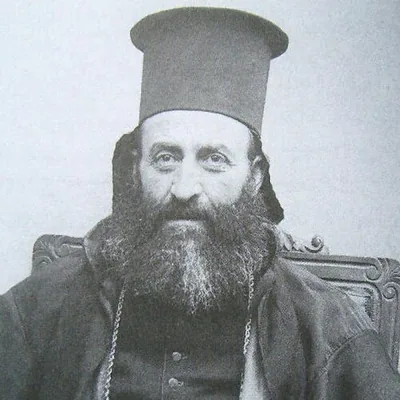
Blessed Flavianus Michael Malke
Syriac Catholic bishop of Gazireh, martyr
Blessed Salvatore Lilli
Franciscan, missionary in Lesser Armenia, martyr
Blessed Salvatore Lilli and his Seven Companions
Martyrs of Marash